
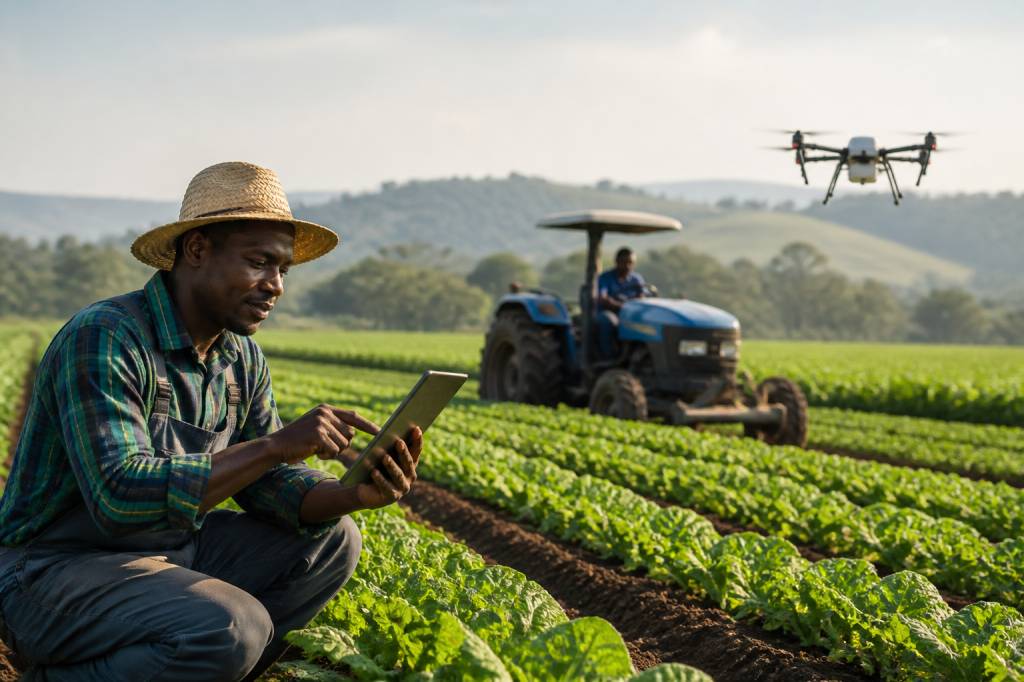
Agriculture is often described as a traditional sector, but that description is increasingly outdated. In many rural regions, farming is becoming a laboratory for technological adoption, business model innovation, and infrastructure investment. The result is not just higher yields. It is a broader economic shift: new income streams, better market access, more resilient supply chains, and stronger links between rural communities and the wider economy.
This matters far beyond the farm gate. Agriculture still supports the livelihoods of hundreds of millions of people worldwide, especially in emerging markets. According to the World Bank, agriculture remains a major source of employment in low-income countries, often accounting for a large share of rural jobs. When innovation improves agricultural productivity, the effects ripple through transport, processing, retail, finance, and local services. In short: when farms become more efficient, rural economies stop depending on weather alone and start depending on systems.
Why rural economies have long lagged behind
For decades, rural economies faced a familiar set of constraints: limited access to capital, weak infrastructure, fragmented landholdings, poor storage capacity, and thin market information. A farmer could produce a surplus one season and still lose money because of post-harvest spoilage or low farmgate prices. Not exactly a perfect incentive structure.
These structural weaknesses kept productivity low and income volatile. They also discouraged investment. Why buy better equipment if roads make it hard to reach buyers, or if a crop can rot before reaching market? Why expand production if financing is expensive and insurance is unavailable? The result was a self-reinforcing cycle: low productivity led to low income, which led to limited reinvestment, which kept productivity low.
Innovation is breaking that cycle in several ways. Some changes are highly visible, such as drones, sensors, and precision irrigation. Others are less glamorous but just as important: digital payments, warehouse receipt systems, mobile credit scoring, and cooperative platforms that connect farmers directly to buyers. The common thread is efficiency. Rural economies are becoming more connected, more data-driven, and less isolated.
Precision agriculture is changing the economics of farming
Precision agriculture uses data and technology to improve decision-making at the farm level. Instead of treating a field as uniform, farmers can now manage soil moisture, nutrient use, pest pressure, and crop health with far greater accuracy. That sounds technical, but the economic logic is simple: fewer wasted inputs, better yields, and lower risk.
In developed markets, large commercial farms have adopted GPS-guided tractors, satellite imagery, and automated irrigation systems. In emerging economies, the same principle is being adapted to smaller farms through mobile-based advisory services, low-cost sensors, and cooperative equipment-sharing models. The scale differs, but the objective is identical: improve output per hectare and reduce losses.
The impact is measurable. Studies by agricultural development organizations have shown that precision irrigation can reduce water use significantly while maintaining or improving yields. In regions facing water stress, this is not only an environmental advantage but also a financial one. Water savings lower operating costs, stabilize production, and reduce exposure to drought. For farmers working on tight margins, that can make the difference between profit and survival.
One practical example is the spread of soil-testing services in parts of East Africa and South Asia. Farmers who previously applied fertilizer based on rough estimates can now receive tailored recommendations. The payoff is often modest on paper, but meaningful in practice: better input efficiency, healthier crops, and higher net income. Agriculture rarely transforms through one dramatic breakthrough. It usually improves through dozens of small gains that add up.
Digital tools are reducing information asymmetry
One of the biggest barriers in rural economies has always been information asymmetry. Farmers often know their harvest volumes, but not the best market prices. Lenders may not understand agricultural cash flows. Buyers may not know which producers can deliver consistently. This lack of transparency raises transaction costs and weakens bargaining power.
Digital platforms are addressing that gap. Mobile phones, now common even in remote areas, have become a basic economic infrastructure. Farmers can check prices, receive weather forecasts, access extension advice, and make payments without relying on intermediaries. That does not eliminate market volatility, but it does improve decision-making.
Consider the growth of mobile money in parts of Sub-Saharan Africa. Its significance goes beyond convenience. Digital payment systems allow farmers to receive proceeds faster, build transaction histories, and gain access to formal financial services. Once a farmer has a digital trail of sales and repayments, lenders can assess risk more accurately. That opens the door to working capital, equipment loans, and input financing.
There is also a governance dimension. Digital records reduce leakage in subsidy programs and improve traceability in supply chains. In sectors such as coffee, cocoa, and horticulture, traceability is increasingly important for export markets. Buyers want to know where products come from, how they were grown, and whether quality standards were met. Digital tools make that easier to verify.
Financing innovation is unlocking rural investment
Access to finance remains one of the most persistent constraints in agricultural development. Traditional banks often view smallholder farming as too risky: seasonal cash flows, weather dependence, and limited collateral all make underwriting difficult. But new financing models are changing the equation.
Fintech firms, agricultural lenders, and development finance institutions are increasingly using alternative data to extend credit. Satellite imagery, mobile transaction histories, repayment behavior, and even agronomic data can help assess creditworthiness. This is not about replacing prudence with optimism. It is about pricing risk more accurately.
Some lenders now bundle credit with crop insurance, input delivery, and buyer contracts. That creates a more stable revenue structure for farmers and reduces default risk for financiers. It also encourages investment in higher-quality seeds, better storage, and mechanization. When financing is tied to productivity, rather than just land ownership, rural entrepreneurship becomes more dynamic.
Warehouse receipt systems are another useful example. Farmers can store crops in certified facilities, use receipts as collateral, and sell later when prices improve. This reduces the pressure to sell immediately after harvest, when prices are often lowest. Economically, it improves bargaining power and can smooth seasonal income volatility. A simple mechanism, but a powerful one.
Agri-tech is creating jobs beyond the field
Innovation in agriculture does not only make existing farms more productive. It also creates new rural employment. As agricultural value chains become more sophisticated, demand grows for logistics operators, equipment technicians, data analysts, food processors, quality control staff, and cold-chain managers.
This is an important point. Rural development is often discussed as though the only job is farming. In reality, modern agricultural economies generate multiple layers of employment. A single export-oriented horticulture cluster, for example, can support packaging facilities, transport services, input dealers, maintenance workshops, and local catering businesses. Development is rarely a one-sector story.
Mechanization and automation are sometimes presented as threats to employment. The reality is more nuanced. Yes, some manual tasks are displaced. But if productivity rises and output expands, new jobs often emerge in complementary services. The challenge is transition, not disappearance. Rural economies that invest in skills training are better positioned to capture these gains.
There is also an entrepreneurship angle. Younger workers who might once have left rural areas for cities are increasingly finding opportunities in agribusiness, digital advisory services, e-commerce, and logistics. That matters because rural outmigration has long drained talent from agricultural regions. If farming becomes more profitable and technologically interesting, the sector is no longer viewed as a dead end. That shift in perception is economically significant.
Infrastructure remains the multiplier
Technology alone does not transform rural economies. It needs infrastructure. Without roads, storage, electricity, internet connectivity, and reliable water systems, innovation is limited. A drone cannot fix a broken supply chain. A mobile app cannot compensate for a washed-out road after harvest season.
This is why public investment remains central. Rural roads reduce transport costs and post-harvest losses. Electrification enables cold storage, irrigation pumps, and processing equipment. Broadband access supports digital advisory services and financial inclusion. These investments raise the return on private innovation.
The economics are straightforward. Lower transaction costs increase market participation. Better storage reduces waste. Improved logistics allow farmers to sell at better times and to more distant markets. And when local processing expands, more value remains in the region rather than being captured elsewhere. In development terms, that is how agriculture moves from subsistence to accumulation.
Some of the most successful examples combine public and private capital. Governments build backbone infrastructure, while agribusinesses, cooperatives, and startups provide services on top. This layered model is more scalable than isolated projects. It also creates ecosystems rather than one-off interventions.
Climate pressure is making innovation non-negotiable
Climate change has turned innovation from a growth option into a survival requirement. Unpredictable rainfall, heat stress, flooding, and new pest patterns are already affecting yields in many regions. Rural economies that depend heavily on agriculture are especially exposed.
Adaptation strategies are now a core part of agricultural development. Drought-resistant seeds, water-efficient irrigation, regenerative soil practices, and climate monitoring systems are becoming more common. These tools do not eliminate risk, but they improve resilience. And resilience has economic value. A farmer who can maintain output through a bad season is more likely to repay loans, retain labor, and invest again the following year.
Insurance is also evolving. Index-based crop insurance, for example, uses weather or satellite data to trigger payouts when conditions breach predefined thresholds. That reduces administrative costs and speeds compensation. It is not perfect, and basis risk remains an issue, but it is a meaningful advance over waiting months for manual assessments.
For insurers, lenders, and policymakers, the message is clear: climate resilience is now part of credit quality. A farm that cannot adapt is a higher-risk asset. That is why environmental innovation and financial stability are increasingly connected.
What policymakers and investors should watch
For governments, the priority is not to subsidize technology for its own sake. It is to build the conditions under which innovation can scale. That means infrastructure, digital connectivity, extension services, land-title clarity, and regulatory frameworks that support competition and transparency.
For investors, the opportunity lies in the intersection of agriculture, fintech, logistics, and climate adaptation. Rural economies are not a niche market. They are large, fragmented, and underserved, which is often where the most durable inefficiencies exist. When those inefficiencies are reduced, value creation can be substantial.
Key indicators worth monitoring include:
- adoption rates of mobile finance and digital advisory services
- investments in irrigation, storage, and cold-chain infrastructure
- growth in agri-processing and rural logistics businesses
- access to seasonal credit and crop insurance
- post-harvest loss reduction across major crops
- productivity gains per hectare and per worker
These metrics matter because they reveal whether innovation is reaching the real economy or staying trapped in pilot projects and conference presentations. The latter is common. The former is what changes rural livelihoods.
Agriculture is becoming a development engine again
For years, agriculture was often treated as a sector to move past on the road to industrialization. That view is too narrow. In many countries, agriculture remains the foundation of rural demand, household income, and export earnings. When improved by technology, finance, and infrastructure, it can become one of the most effective engines of broad-based development.
The deeper lesson is that rural economies do not need to remain low-productivity by default. Innovation can raise farm incomes, attract capital, create jobs, and improve resilience. It can also make agriculture more attractive to younger generations who are otherwise inclined to see the sector as outdated.
The transformation is already visible: farmers using smartphones to negotiate prices, cooperatives accessing digital credit, processors expanding cold storage, and investors treating agri-value chains as strategic assets rather than peripheral activity. That is not a romantic story. It is a practical one. And in economics, practicality usually outperforms nostalgia.