
Artificial intelligence is changing the economics of work. It can draft a report in seconds, classify thousands of documents, generate software code and answer routine customer questions. But these capabilities do not translate neatly into a simple forecast of mass unemployment. In most workplaces, AI changes tasks before it eliminates jobs. The central question is therefore not only which occupations may shrink, but how work will be reorganized—and who will gain the skills and bargaining power to benefit.
For businesses, the shift is already strategic. Automation can reduce operating costs and increase output, but it also requires investment in data, software, cybersecurity and employee training. For workers, the challenge is more personal: which parts of a role are vulnerable, and which capabilities become more valuable when machines handle routine work? The answer varies by industry, occupation and the way a company chooses to deploy the technology.
Automation targets tasks, not job titles
A job is a bundle of activities. An accountant may reconcile transactions, interpret financial statements, explain a variance to a client and decide whether an unusual entry requires investigation. AI can support the first tasks more readily than the last two. Treating the whole occupation as either “automatable” or “safe” misses this distinction.
This task-based view helps explain why forecasts can sound contradictory. The International Labour Organization’s 2023 analysis of generative AI found that clerical work was among the occupations with the greatest exposure, while emphasizing that job augmentation was more likely than full automation for most occupations. Exposure means that technology could affect tasks; it does not mean that every affected job will disappear.
Generative AI adds a new dimension to automation because it can work with language, images and code, not just repetitive physical processes or structured data. That makes some professional and administrative tasks more exposed than earlier waves of automation. Yet exposure still depends on accuracy requirements, regulation, customer expectations and the cost of integrating AI into real workflows.
Consider a bank’s customer-service team. A system might summarize a client’s account history, suggest responses to common questions and route complex cases to specialists. This could reduce the time spent searching through records without removing the need for staff to handle complaints, assess unusual circumstances or explain decisions. The job changes; the human contribution shifts toward judgment and accountability.
What the headline forecasts do—and do not—say
Large estimates of AI’s potential can be useful, but they are often misread. In 2023, McKinsey estimated that generative AI could add the equivalent of $2.6 trillion to $4.4 trillion annually to the global economy across the use cases it analyzed. This was an estimate of potential economic value, not a forecast of wages, realized productivity or jobs lost. Capturing that value depends on adoption, implementation and the ability of organizations to redesign work.
The World Economic Forum’s 2023 Future of Jobs Report projected significant job creation and displacement by 2027 among the employers surveyed. Its findings point to a labor market in motion, not a universal prediction that a fixed share of workers will be replaced by AI. Results depend on the sample, the time horizon and the report’s definitions of job creation and displacement.
The distinction matters for investors and policymakers. A company can deploy automation to expand output rather than cut headcount. It may also reduce hiring, reorganize teams or shift workers into new roles. The same technology can therefore increase productivity while producing very different employment outcomes across firms.
Which tasks are changing first?
AI is most immediately useful where work involves large volumes of digital information, repeatable processes and outputs that can be checked. Common examples include summarizing documents, searching internal knowledge bases, drafting routine communications, extracting data from forms and generating first versions of code or marketing materials.
In finance and insurance, these capabilities can affect several functions:
- Customer operations: chatbots and agent-assistance tools can handle routine questions or surface relevant policy information.
- Claims processing: systems can classify documents, flag missing information and help prioritize cases for review.
- Risk and compliance: machine-learning tools can identify patterns for investigation, while human teams assess context and meet regulatory obligations.
- Research and analysis: generative tools can summarize disclosures or organize market information, but analysts remain responsible for verifying facts and explaining assumptions.
These are examples of assistance, not automatic permission to delegate decisions. In a regulated environment, an erroneous answer can create financial, legal and reputational costs. A model that produces a fluent explanation is not necessarily producing a correct one. Human review, audit trails and clear accountability remain central to responsible deployment.
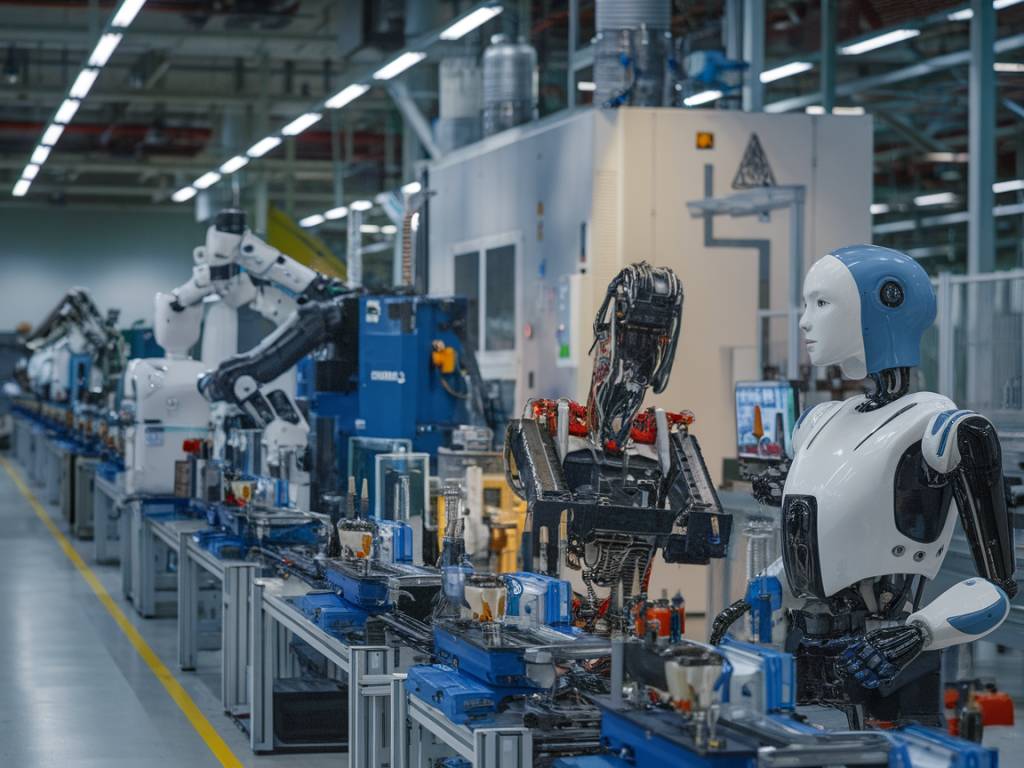
Physical automation follows a different path. Robotics and machine vision can transform warehouses, factories and logistics, but installation requires equipment, suitable facilities and reliable operations. Software-based AI may be easier to test in an office workflow; physical automation often demands greater upfront capital and changes to the production environment.
Skills that gain value in an AI-enabled workplace
When routine tasks become faster, employers still need people who can define the problem, judge the result and act on it. The most durable skills are not limited to technical expertise. They combine domain knowledge with critical thinking, communication and sound decision-making.
- AI and data literacy: understanding what a system can do, where its limitations lie and how to check its output.
- Analytical judgment: distinguishing a useful pattern from a misleading correlation or an unsupported claim.
- Domain expertise: applying knowledge of finance, law, health, operations or customer needs to a specific decision.
- Communication: translating technical findings into clear recommendations for colleagues, clients and managers.
- Adaptability: learning new tools and adjusting processes as technology and business needs change.
- Ethical and regulatory awareness: recognizing privacy, bias, security and accountability risks before they become costly failures.
Prompt writing may help employees use generative systems more effectively, but it is not a substitute for expertise. A well-phrased request can still produce a confident mistake. The more valuable capability is knowing what to ask, what evidence to demand and when the result should not be used.
For an investment analyst, for example, AI may summarize earnings-call transcripts and identify recurring themes across companies. The analyst’s advantage lies in checking the transcript, comparing the summary with reported figures, assessing management credibility and connecting the findings to valuation. Faster information processing can improve the work—but only if professional judgment remains in the loop.
Productivity gains are not automatic
Adopting AI does not guarantee a productivity boost. New systems can create extra work: employees may need to correct outputs, reconcile conflicting information or learn several tools that do not connect to existing software. Poor-quality data can undermine performance, while unclear responsibility can slow decisions rather than accelerate them.
There is also a measurement problem. If an employee completes a task in less time, that does not necessarily mean the organization has become more productive. The saved time might be absorbed by additional review, duplicated processes or more output of limited value. Firms need to measure outcomes such as processing time, error rates, customer satisfaction and cost per completed task—not simply the number of AI tools purchased.
For managers, a sound implementation starts with a specific operational problem. A company might test whether an assistant reduces the time required to locate policy information, then compare results with a baseline and monitor error rates. A limited pilot makes it easier to identify risks before the system is introduced across an entire department.
Who captures the economic benefits?
AI’s labor-market effects will depend partly on how productivity gains are distributed. If a tool enables the same team to produce more, the benefits might appear as higher profits, lower prices, improved services, higher wages or some combination. Technology alone does not determine the outcome. Competition, labor institutions, management choices and workers’ ability to negotiate all matter.
Smaller firms may benefit from access to capabilities that once required large specialist teams. At the same time, companies with stronger data, computing resources and technical expertise may be better positioned to adopt AI at scale. This could widen gaps between firms, even as the underlying tools become widely available.
Workers may also experience unequal effects within the same occupation. Employees who can use AI to increase the quality or speed of their work may gain an advantage, while those whose responsibilities consist largely of standardized tasks face greater pressure to retrain or move. Access to training, time to learn and employer support will influence how manageable that transition is.
What employers and workers can do now
Businesses do not need to predict every technological breakthrough to prepare. They can map tasks, identify where AI may offer measurable value and involve employees in redesigning workflows. Frontline staff often know where delays, repetitive handoffs and errors occur. Their input can make adoption more practical and reduce the risk of building a system around an imagined process.
Employers should also establish clear rules for sensitive information, human review and responsibility for decisions. In finance and insurance, the standard should be particularly high when tools affect customer eligibility, claims, credit or investment decisions. Compliance teams need to understand not only what a model produces, but which data it uses and how its outputs are monitored.
Workers can take a similarly practical approach:
- List the recurring tasks in a role and identify which require judgment, trust or human interaction.
- Experiment with approved tools on low-risk tasks, then verify results against reliable sources.
- Strengthen a core professional skill rather than relying on generic familiarity with AI.
- Ask employers what training, data safeguards and review procedures are available.
Public policy has a role as well. Education and workforce programs can help people build both technical and transferable skills, while labor-market data can identify where demand is changing. Social protections and access to retraining become more important when transitions are rapid or concentrated in particular regions and occupations.
The next phase of work
The future of work will not be determined by what AI can do in a demonstration. It will be shaped by whether organizations can integrate it reliably, whether customers accept its use, how regulators respond and how workers share in the gains. Some tasks will disappear, some roles will be redesigned and new activities will emerge. The pace will differ across sectors.
For employees, the practical priority is to become effective at working with automated systems while retaining the judgment to challenge them. For employers, it is to treat AI as a redesign of work, not merely a software purchase. And for policymakers, the task is to make adaptation possible without assuming that every worker can absorb the cost alone.
Automation is reshaping jobs, but the outcome is not fixed. The firms that benefit most are likely to be those that pair technology with skilled people, careful controls and a clear understanding of the work being improved. In that environment, the competitive edge will not belong simply to the worker or company using the most AI, but to the one using it with the best judgment.